Water
Mitigation
From flood walls to seawalls, Redi-Rock BC can help.
Stormwater Management Has Become a Structural Issue in BC
Rainwater runoff from impervious development surfaces is a primary contributor to downstream water quality issues in lakes and streams. Urbanization alters watershed hydrology, increasing:
- Stream bank erosion
- Sediment transport
- Habitat degradation
- Peak runoff volumes
Redi-Rock and BC Stormwater Management
Stormwater runoff, rising winter rainfall intensity, and shoreline erosion are increasing across BC’s Coast, placing aging drainage systems and natural banks at risk of failure. Atmospheric rivers create a deluge of rainfall that impacts roadways and infrastructure.
We must build for the future to prevent catastrophic episodes that damage or destroy property and impact the safety of BC residents. Increased storm frequency on coastal communities have already overwhelmed aging infrastructure increasing the flood risk exponentially.
Redi-Rock’s durable, erosion-resistant retaining systems withstand high seasonal rainfall, fluctuating water levels, and freeze–thaw cycles common across the province.
Why is Redi-Rock the Best Solution for Water Mitigation?
Redi-Rock retaining wall systems provide engineered retention and erosion control to stabilize land, manage runoff, and protect infrastructure in water-adjacent environments.
When Water Forces
Meet Unstable Soils
Storm and flood channel stabilization projects introduce hydraulic and geotechnical challenges not typically encountered in conventional retaining wall applications, including variable flow velocities, saturated subgrades, and dynamic scour potential.
Freeze-thaw
Exposure
Manufactured from structural-grade, air-entrained concrete, Redi-Rock blocks are designed to perform under prolonged submergence and repeated freeze-thaw exposure common in open channel and flood conveyance environments.
Optimized for
Confined Flow Paths
Redi-Rock systems can be installed efficiently within constrained drainage corridors, while their textured face profiles help dissipate flow energy and reduce localized velocity at the channel interface.
Built for Hydraulic
Resilience
For stormwater and flood channel infrastructure, Redi-Rock provides hydraulic durability, installation efficiency, and erosion resistance beyond that of conventional cast-in-place or small-format segmental wall systems.
Applications in BC Water Management Projects
Redi-Rock Walls are commonly used in:
- Waterfront property remediation
- Increase space for storm water channels
- Streambank stabilization
- Stormwater detention ponds
- Ravine subdivision protection
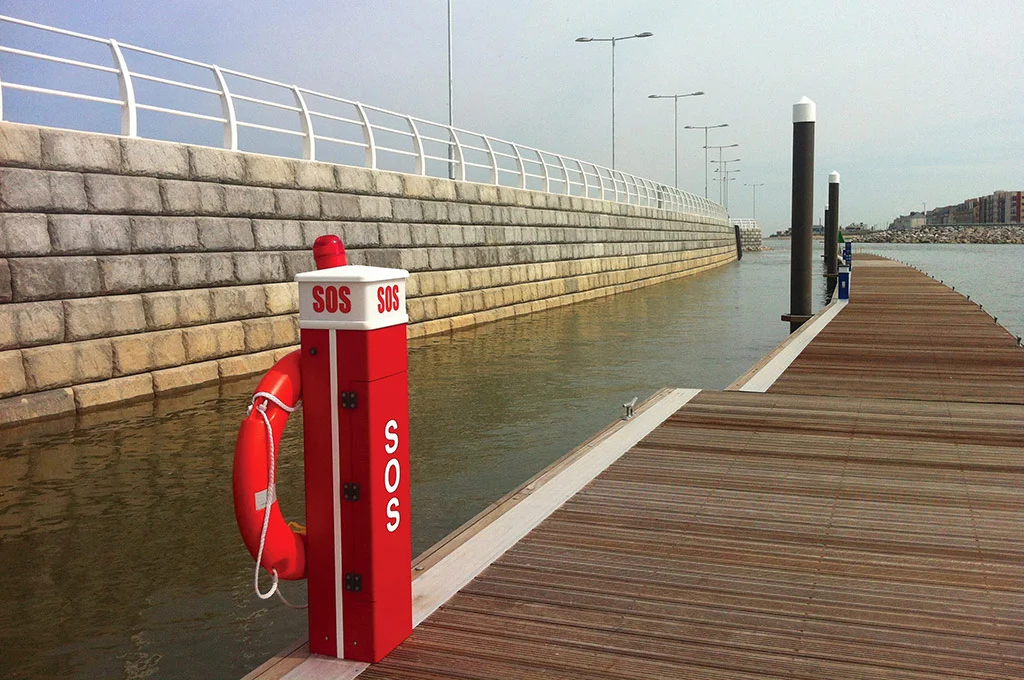
- Shoreline protection
- Coastal slope retention
- Infrastructure adjacent to fish-bearing creeks
- Create sturdy storm ready walk ways along shorelines
- Protect roadways from storm wash outs and flooding
Design Considerations for High-Rainfall and Storm Water Environments
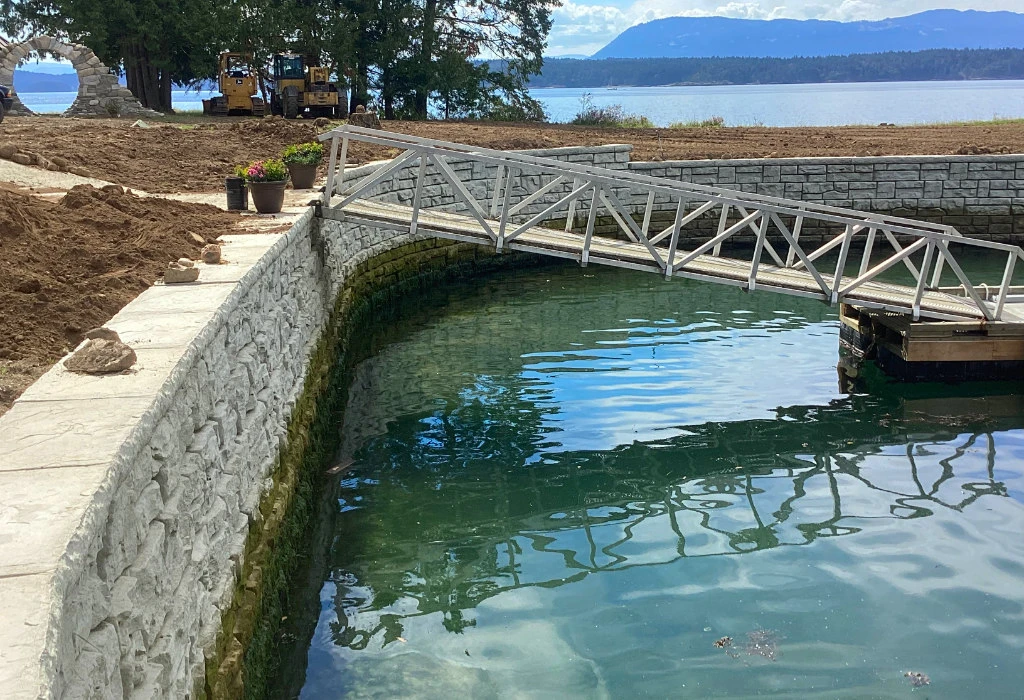
In high-rainfall regions like coastal BC, retaining walls must be designed to manage increased hydrostatic pressure and prevent soil saturation behind the structure.
Key considerations include:
- Adequate subsurface drainage to relieve water buildup
- Free-draining reinforced backfill
- Proper toe protection to prevent scour and undermining
- Erosion control at outfalls and flow transition points
- Structural capacity to accommodate saturated soil loads
Designing for controlled water movement and not just retention, is critical to maintaining long-term wall stability in storm water-impacted environments. Whether stabilizing stream banks, reinforcing foreshore slopes, or constructing floodplain protection infrastructure, Redi-Rock offers a durable, engineered solution designed for water-impacted environments—while maintaining a natural stone appearance that integrates seamlessly into BC’s sensitive landscapes.
Case Study
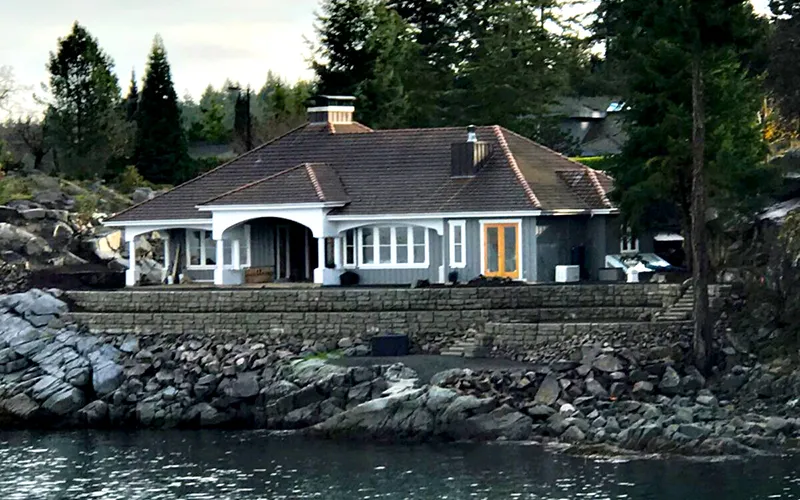
Shoreline Stabilization for Residential Waterfront Property – Vancouver Island, BC
A residential waterfront property on Vancouver Island required shoreline stabilization to address ongoing erosion caused by tidal fluctuation, storm surge, and saturated native soils.
In addition to slope retention, the design needed to support new outdoor living infrastructure constructed immediately adjacent to the shoreline, within a constrained setback area.