
Lessons From New Zealand That Apply Directly to British Columbia
Across much of British Columbia, particularly along coastal corridors and in hillside communities, infrastructure is frequently constructed adjacent to waterways and on steep, rock-based slopes. Combined with prolonged rainfall and seasonal storm events, these conditions often lead to erosion at the toe of slopes — undermining roads, destabilizing embankments, and increasing the risk of progressive slope failure.
Following a major storm event in Gisborne, New Zealand, coastal erosion removed a significant portion of the slope supporting an active roadway. The remaining embankment was compromised, with shallow bedrock limiting excavation and a constrained footprint restricting access for conventional reinforced retaining systems.
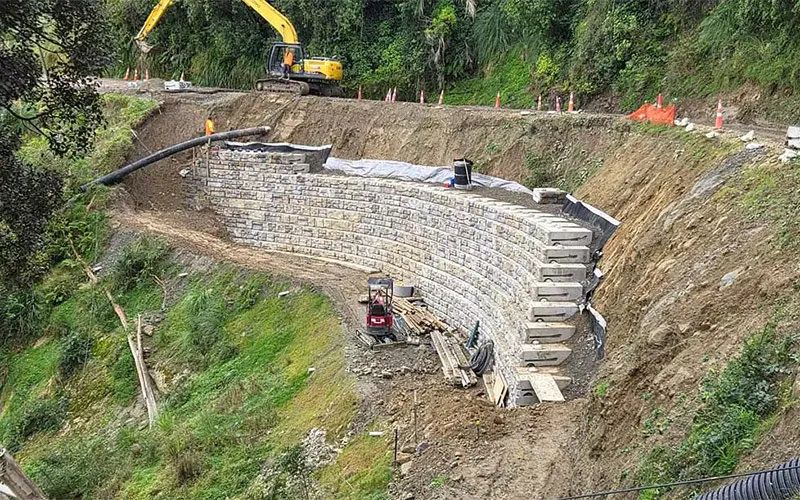
Installation was completed by a small crew in approximately 10 days using standard lifting equipment.
Engineers required a solution that could:
- Stabilize the remaining slope without deep excavation
- Be founded directly on competent native material or rock
- Install within tight working space adjacent to an active roadway
- Provide long-term resistance to hydraulic erosion
- Be constructed quickly to prevent further loss of support
Design Considerations
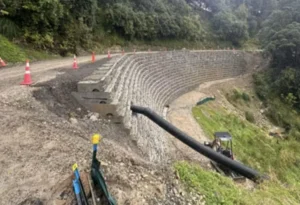
A Redi-Rock gravity wall system was selected due to its ability to rely on mass rather than soil reinforcement or deep foundations.
A Redi-Rock gravity wall system was selected due to its ability to rely on mass rather than soil reinforcement or deep foundations. The large-format precast blocks were installed on a levelled granular base placed directly over the existing rock substrate, eliminating the need for extensive undercutting or piling — a common challenge in British Columbia projects where competent bearing strata are shallow but irregular.
The system’s one-ton units created immediate structural mass at the slope face, allowing the wall to resist lateral earth pressures and surcharge loads from the roadway above. Integrated setback between courses provided additional batter, improving global stability while maintaining a relatively small footprint — critical in sites where right-of-way or environmental constraints limit wall embedment depth.
Drainage stone and geo grid were incorporated behind the wall to relieve hydrostatic pressure — a key design consideration in both New Zealand and BC’s high-rainfall environments. This allowed the reconstructed slope to manage groundwater movement and stormwater infiltration without compromising retained soils.
Installation Processes & Timeline
Installation was completed by a small crew in approximately 10 days using standard lifting equipment. Because the gravity system did not require soil reinforcement extending into the retained zone, construction was able to proceed without large-scale excavation behind the wall — minimizing disruption to the roadway and reducing environmental impact near the shoreline.
The finished structure reached heights of approximately 6.4 metres (21 feet), restoring slope integrity and protecting the roadway from further erosion-related failure.
For roadway infrastructure, riverbanks, and coastal developments throughout British Columbia, gravity wall systems offer a practical solution where wet conditions, shallow rock, and limited access often make traditional reinforced retaining systems difficult to implement. By combining rapid installation with inherent mass stability and integrated drainage capability, the system provided a durable long-term response to an immediate geotechnical challenge.
Project Details
Project Name: Mangapoike Slip Repair
Owner: Wairoa District Council Contractor:
Quality Road Services Engineer: Nithin Sugathan
Architect/Designer: WSP Napier
Manufacturer: Duracrete Products
Location: Mangapoike, Hawkes Bay, New Zealand
Wall Type: Gravity
Texture: Ledgestone
Year Built: 2025
https://www.redi-rock.com/knowledge-hub/new-zealand-gravity-wall-restores-road/
Related Projects
A Step-by-Step Guide for Sloped, Shoreline & Small-Footprint Properties STEP 1 — Identify the Problem to Solve Many homes across....
Bridge-Crossing Problem As part of a $300M redevelopment in Dartmouth, Nova Scotia, engineers were tasked with constructing multiple bridge crossings....
Lessons From New Zealand That Apply Directly to British Columbia Across much of British Columbia, particularly along coastal corridors and....
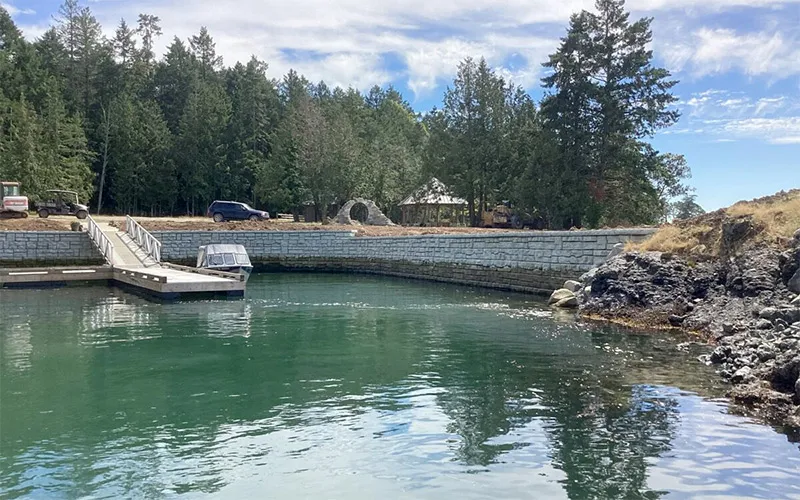
Project Overview Before: decades of erosion and structural failure A private marina on a Gulf Islands, British Columbia....