Retaining Wall Questions, Answered.
Redi-Rock BC is your retaining wall specialist in British Columbia, Canada.
Redi-Rock FAQs
Retaining walls play a critical role in site development—providing structural support, managing grade changes, and protecting infrastructure from soil movement, erosion and water.
Whether you’re designing for load-bearing performance, optimizing constructability, or evaluating long-term durability, the right wall system can significantly impact both project timelines and outcomes. Know before you start the planning process on how and what the best retaining wall system will be for your project.
Below are answers to some of the most common questions engineers, developers, and contractors ask when planning a retaining wall system.
Construction
Redi-Rock offers a wide range of planning and installation resources to support projects from concept through construction. This includes technical manuals, installation guides, standard construction details, and case studies covering a variety of applications, from rail and highway infrastructure to large commercial retaining walls, residential landscape walls, water retention systems, flood control, and erosion protection.
These resources are designed to assist engineers, contractors, and developers in selecting the right wall system and installing it efficiently across a broad range of site conditions. Our local team in BC can help you plan your project, provide quotes and connect you to Redi Rock International experts and local engineers.
The most appropriate Redi-Rock wall system depends on your site’s soil conditions, wall height, and additional loads from slopes, structures, or traffic.
Gravity Walls are typically suitable for lower-height applications with minimal surcharge loads and good soil conditions.
Geogrid-Reinforced (MSE) Walls are used for taller walls, steeper slopes, or where additional loads are present (e.g., driveways, buildings, or roadways).
Hybrid or Anchored Systems may be considered in space-constrained sites or where poor soils or erosion and water factors are a concern, common in many BC applications.
A geotechnical or structural engineer should review site-specific factors to determine the most effective and economical wall design for your project.
For Redi-Rock walls, the need for geogrid reinforcement depends on site conditions, not just wall height. Soil type, nearby loads (like driveways or buildings), drainage, and slopes, all play a role.
As a general guideline:
Walls up to ~1.2 m may be built as gravity walls in good conditions.
Walls over ~1.2 m should be reviewed by an engineer.
Walls above ~1.8–2.0 m will typically require geogrid reinforcement and an engineered design.
Final requirements should always be confirmed by a qualified engineer based on your specific site.
Redi-Rock retaining walls require proper drainage to relieve hydrostatic pressure and maintain long-term stability.
A typical system includes free-draining granular backfill, a perforated base drain, geotextile separation fabric, and site grading to direct surface water away from the wall. For reinforced (MSE) walls, drainage must also protect the geogrid-reinforced soil zone from saturation.
Final drainage design should be based on site-specific geotechnical conditions, particularly in high rainfall regions such as British Columbia.
Reference: PMB-Design-Manual-Drainage-Best-Practices
You can request the complete PMB Design Manual on the Redi-Rock site.
Surcharge loads — such as traffic, buildings, or nearby slopes — increase the lateral pressure acting on a retaining wall. How they are analyzed depends on the type and location of the load.
There are two primary methods used in wall design:
1. Uniform Surcharge Load
When the surcharge (for example, consistent traffic loading) is evenly distributed, it is modeled as a uniform horizontal pressure applied along the back of the wall. This assumes the load extends across the entire retained area.
2. Non-Uniform or Offset Loads (Boussinesq Distribution)
When the surcharge is concentrated (such as a building footing) or set back from the wall, engineers use a Boussinesq distribution. This method more accurately calculates how the load spreads through the soil before reaching the wall.
A key benefit of the Boussinesq approach is that it accounts for the distance between the surcharge and the wall. In general, the farther the load is set back, the less lateral pressure it exerts on the wall.
Please request the PMB Design Manual for surcharge load analysis.
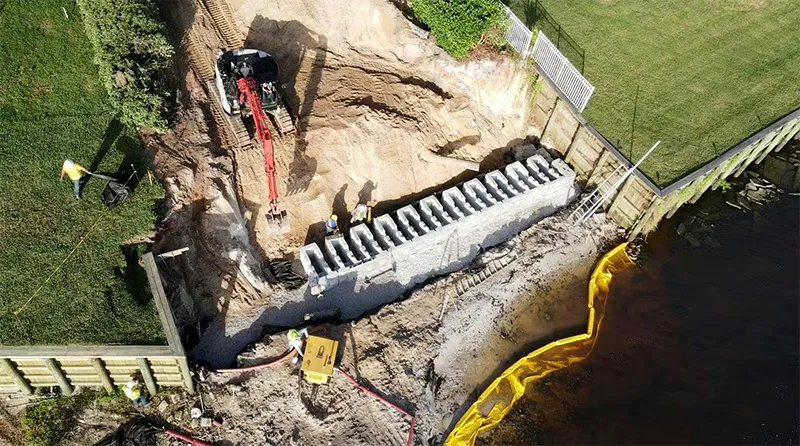
Redi-Rock retaining walls are engineered to be installed simply and with small crews.
- Installation equipment will vary depending on your soil.
- Standard equipment such as an excavator or forklift is typically sufficient for installation.
- A properly prepared and compacted granular base is essential for long-term performance.
- Basic PPE (steel-toed boots, hard hats, hearing protection) should be used on site.
- Technical support are available to assist crews in the field.
Installation guides
,
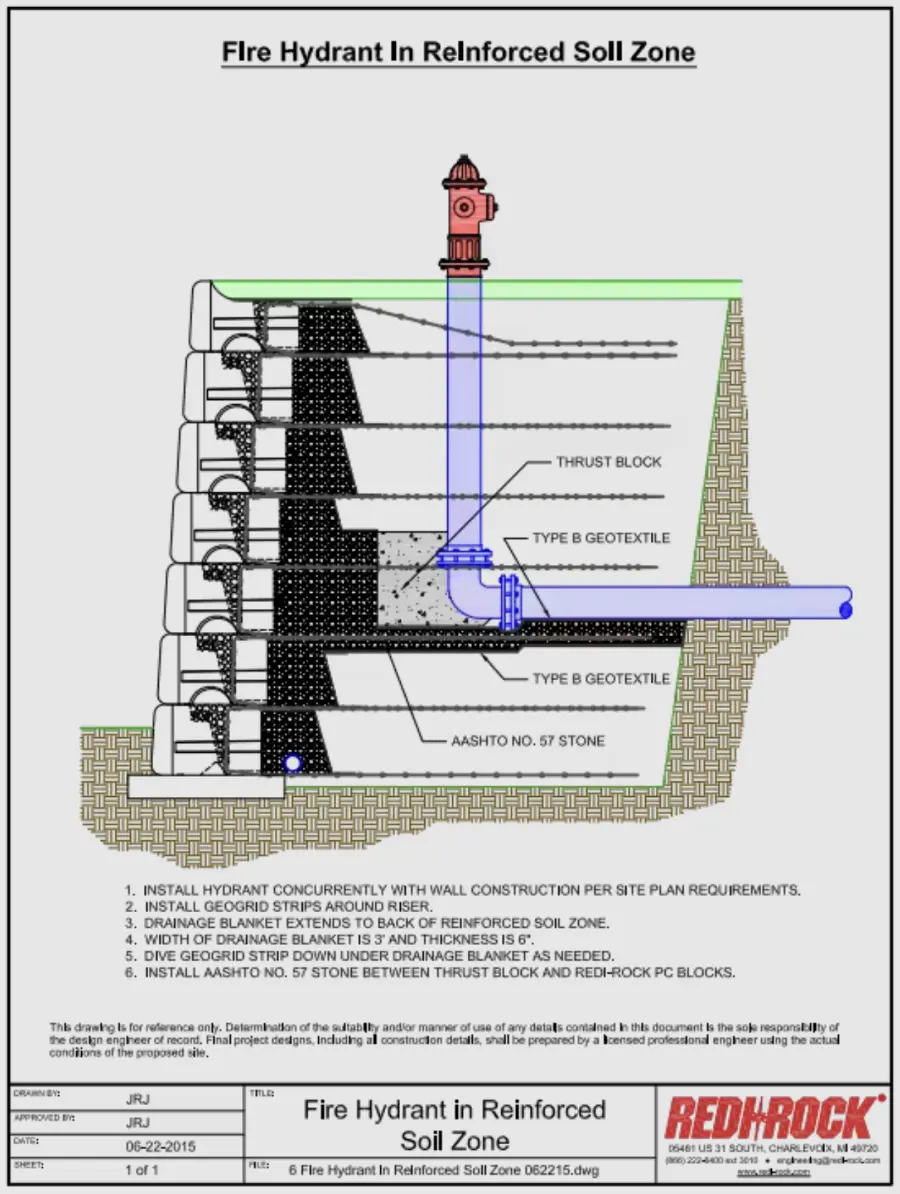 Redi-Rock blocks can be incorporated into drainage structures such as culvert headwalls and outfalls. The modular system allows walls to be constructed around pipe penetrations and other hydraulic components, making it adaptable for a range of stormwater and infrastructure applications.
Project-specific construction details are available to support the integration of Redi-Rock with pipes and utility crossings.
Installed costs for a Redi-Rock retaining wall in Canada depends on site access, wall height, reinforcement requirements, and local soil conditions, geogrid reinforcement requirements. Final pricing should always be based on a site-specific estimate and engineered design where required. Redi-Rock can offer meaningful installation cost savings compared to cast-in-place or small block retaining wall systems.
Because the blocks are manufactured off-site, there is no formwork, rebar tying, or on-site concrete placement required, which reduces labour time and eliminates curing delays. Installation can typically be completed by a smaller crew using standard excavation equipment, helping to lower both manpower and equipment costs.
The large modular block design also allows for faster installation timelines, which can reduce site disruption and overall project schedules—particularly beneficial on tight-access or sloped BC sites.
In BC applications, costs are most impacted by:
- Sloped terrain and excavation requirements
- Drainage and groundwater management
- Reinforcement (geogrid) for walls above ~1.8–2.0 m
- Equipment access on tight residential or hillside sites
Design
When building steps, the installation follows similar best practices as the wall itself. A properly prepared and compacted crushed stone base is required beneath each step to promote drainage and help manage groundwater—an important consideration in coastal and high rainfall regions like British Columbia. This base preparation helps prevent water buildup, frost movement, and long-term settlement on hillside applications.
Redi-Rock is frequently used to create functional landscape features such as seating walls, outdoor terraces, and amphitheatre-style gathering spaces that integrate seamlessly with the environment and other retaining wall elements.
These applications are especially well-suited for BC’s sloped sites, where outdoor living areas often need to be built into grade. The modular block system and natural stone textures allow designers to create durable, low-maintenance spaces that complement both residential and commercial landscapes.
A great BC example is the outdoor terrace at Township Brewing Inc., where Redi-Rock was used to help shape and support an inviting outdoor seating area built into the surrounding terrain.
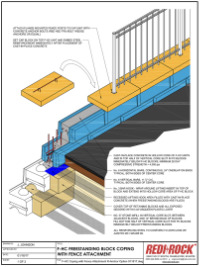
Fencing can be incorporated above Redi-Rock walls in residential applications, achieving two goals at one time. Fence height, post spacing, and material type should be considered. A site-specific review is recommended to ensure the wall system is designed to safely support these added forces. Construction details for integrating fences with Redi-Rock walls are available to help guide proper installation.