Bridge & Highway
Earth Stabilization
Transportation Corridor Earth Retention with Redi-Rock.
Reinforcing Infrastructure in BC for the Future
Across British Columbia’s roadway network, erosion and slope instability present increasing risks to transportation infrastructure, including bridge approaches, highway embankments, culvert crossings, and critical corridors — as seen during the 2021 Coquihalla Highway washout and subsequent emergency restoration.
High rainfall, stormwater conveyance, and seasonal runoff routinely impact retained slopes supporting transportation corridors, leading to embankment settlement, loss of toe support, culvert exposure, or progressive slope failure beneath road structures — affecting serviceability and long-term infrastructure performance.
Redi Rock and Infrastructure Management
In bridge and highway environments where right-of-way constraints, shallow rock, or adjacent infrastructure limit excavation depth, retaining systems must function as engineered structural earth retention solutions capable of resisting lateral earth pressures and traffic surcharge loading.
Redi-Rock precast modular retaining wall systems provide gravity and reinforced earth retention structures suitable for roadway infrastructure applications in erosion-prone or hydraulically influenced environments that have a long service life.
Redi-Rock Retaining Systems is the Best Solution for Transportation Infrastructure
Redi-Rock retaining wall systems are designed to support roadway embankments and bridge approaches in environments where:
- Excavation depth is limited by bedrock
- Construction occurs adjacent to active traffic
- Stormwater runoff impacts retained soils
- Toe erosion compromises slope support
- Infrastructure surcharge loads must be accommodated
Large-format wet-cast modular blocks provide structural mass to resist lateral loads without requiring deep foundations or extended reinforcement zones, allowing installation within constrained transportation corridors.
Why Use Redi-Rock for MOTI & Municipal Road Projects?
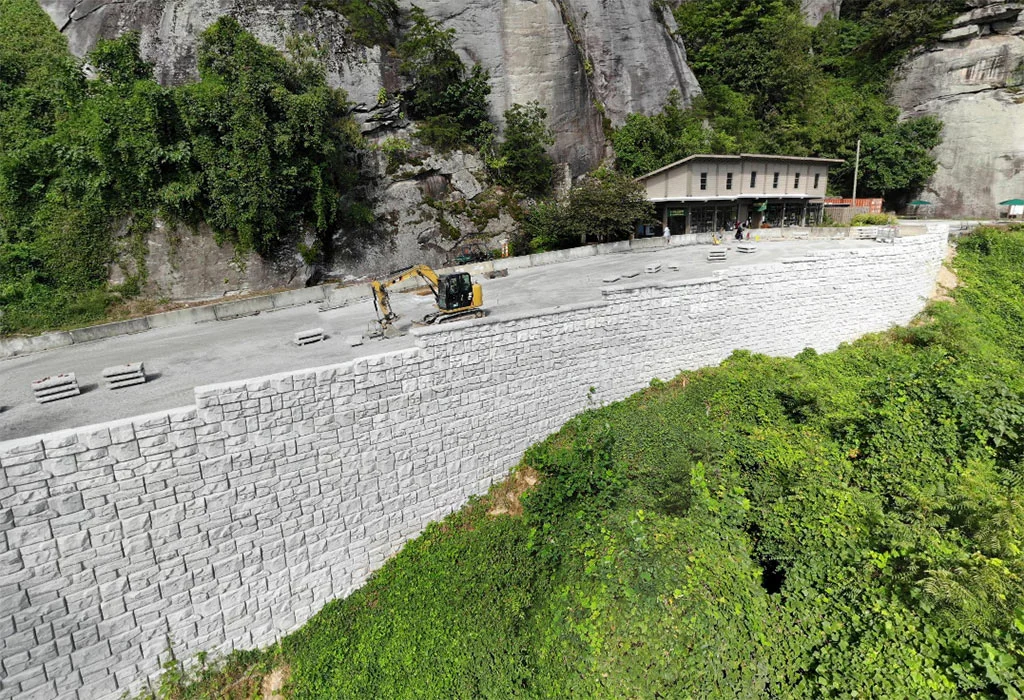
Conventional reinforced retaining systems often require excavation beyond available right-of-way limits for soil reinforcement placement. Redi-Rock gravity, reinforced, and hybrid retaining wall systems minimize excavation behind the wall face, allowing installation within limited footprints while maintaining structural stability for roadway embankments and bridge infrastructure.
Foundation Conditions Adjacent to Roadways
Redi-Rock retaining systems can be founded directly on native soils or shallow bedrock commonly encountered along BC transportation corridors, reducing excavation requirements near bridge abutments, culverts, and highway embankments.
Accelerated Construction Timelines
Machine-set modular block installation supports rapid wall construction using smaller crews — reducing traffic disruption and enabling emergency stabilization where roadway washouts or embankment failures have occurred.
Hybrid Retention for Surcharge Loading
Redi-Rock Hybrid Wall Systems incorporate geo grid reinforcement where required to support traffic surcharge loads from highways, bridge approaches, and roadway infrastructure within constrained right-of-way conditions.
Long-Term Embankment Protection
Wet-cast gravity retaining wall systems are capable of providing 75–100 years of service life when properly designed and installed, protecting roadway embankments and transportation infrastructure from erosion-related instability.
Applications in BC Bridge & Highway Projects
Redi-Rock retaining wall systems are utilized in transportation infrastructure applications including:
- Bridge approach stabilization
- Highway embankment support
- Culvert inlet and outlet protection
- Roadway widening projects
- Drainage channel retention
- Transportation corridor grade separation
- River crossing and shoreline road protection
Where wall heights exceed gravity design limits (typically ~6 m depending on site conditions), reinforced retaining wall systems incorporating geogrid may be used to resist additional lateral loads while maintaining long-term durability in high-rainfall environments. For significant grade transitions, reinforced retaining systems such as the Redi-Rock Positive Connection (PC) System may be used to achieve wall heights exceeding 12.5.
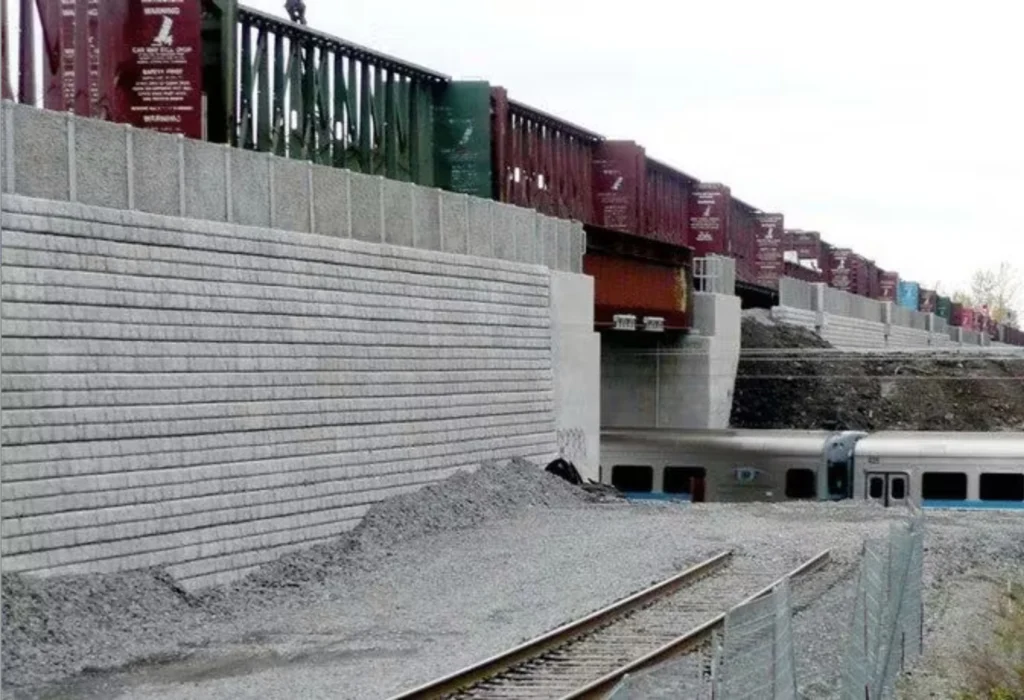
Design Considerations for Roadway Embankments and Storm Water Environments
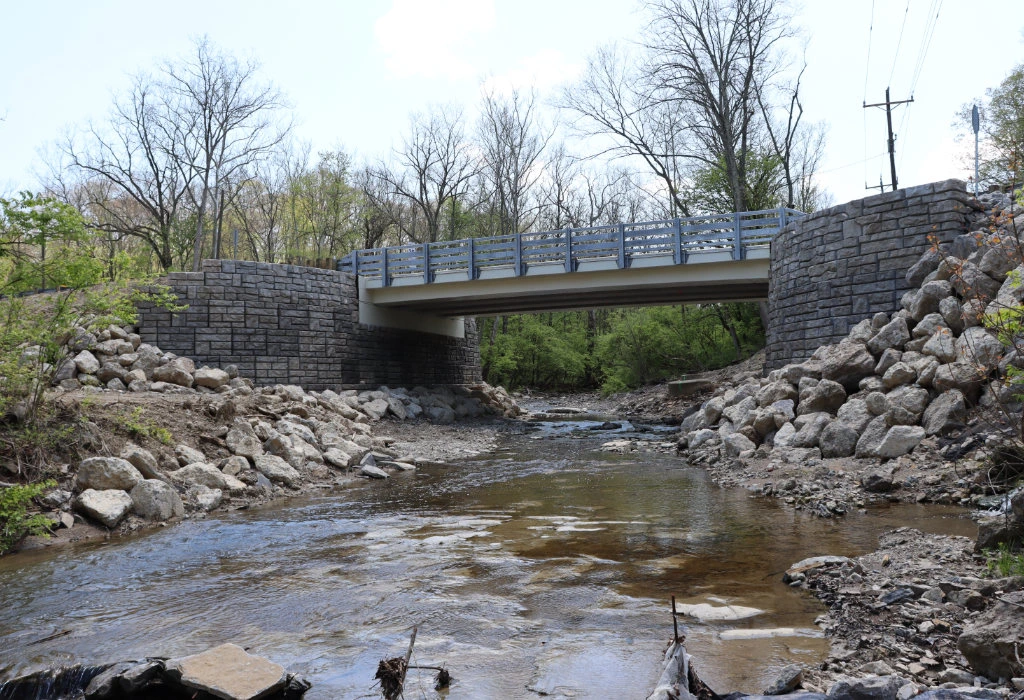
Retaining wall systems for transportation infrastructure in BC must be designed to account for lateral earth pressures, hydrostatic loading, and surcharge loads from roadway infrastructure.
Hydrostatic pressure develops when groundwater or stormwater accumulates within retained soils, increasing lateral force against the retaining structure and reducing slope stability if not properly managed.
Design considerations for bridge and highway applications include:
- Granular drainage zones behind wall face
- Base preparation on native or rock subgrade
- Wall batter to improve global stability
- Accommodation of traffic surcharge loads
- Minimizing excavation within erosion-sensitive areas
Reinforced, gravity and hybrid wall configurations can also be implemented to manage lateral loading from retained soils and traffic surcharge loads while maintaining constructability within active transportation corridors.
Case Study
Coastal Roadway Stabilization in Mountainous, High-Rainfall Environments
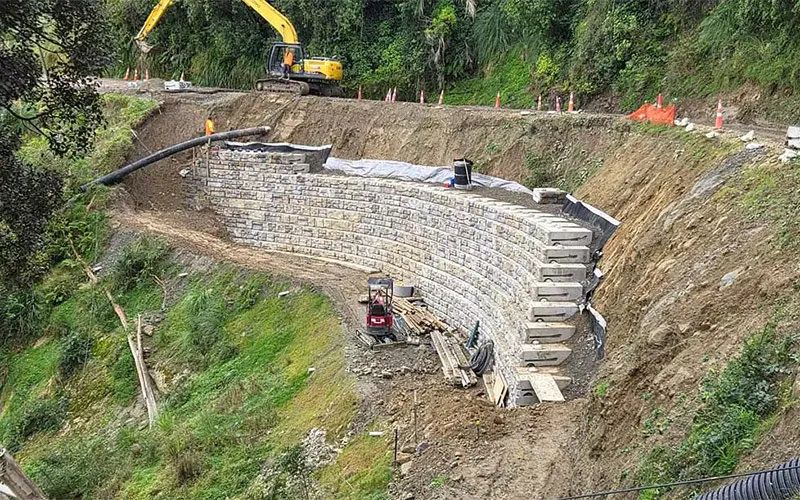
Following a major storm event in Gisborne, New Zealand, coastal erosion removed a significant portion of the slope supporting an active roadway.
The remaining embankment was compromised, with shallow bedrock limiting excavation and a constrained footprint restricting access for conventional reinforced retaining systems.